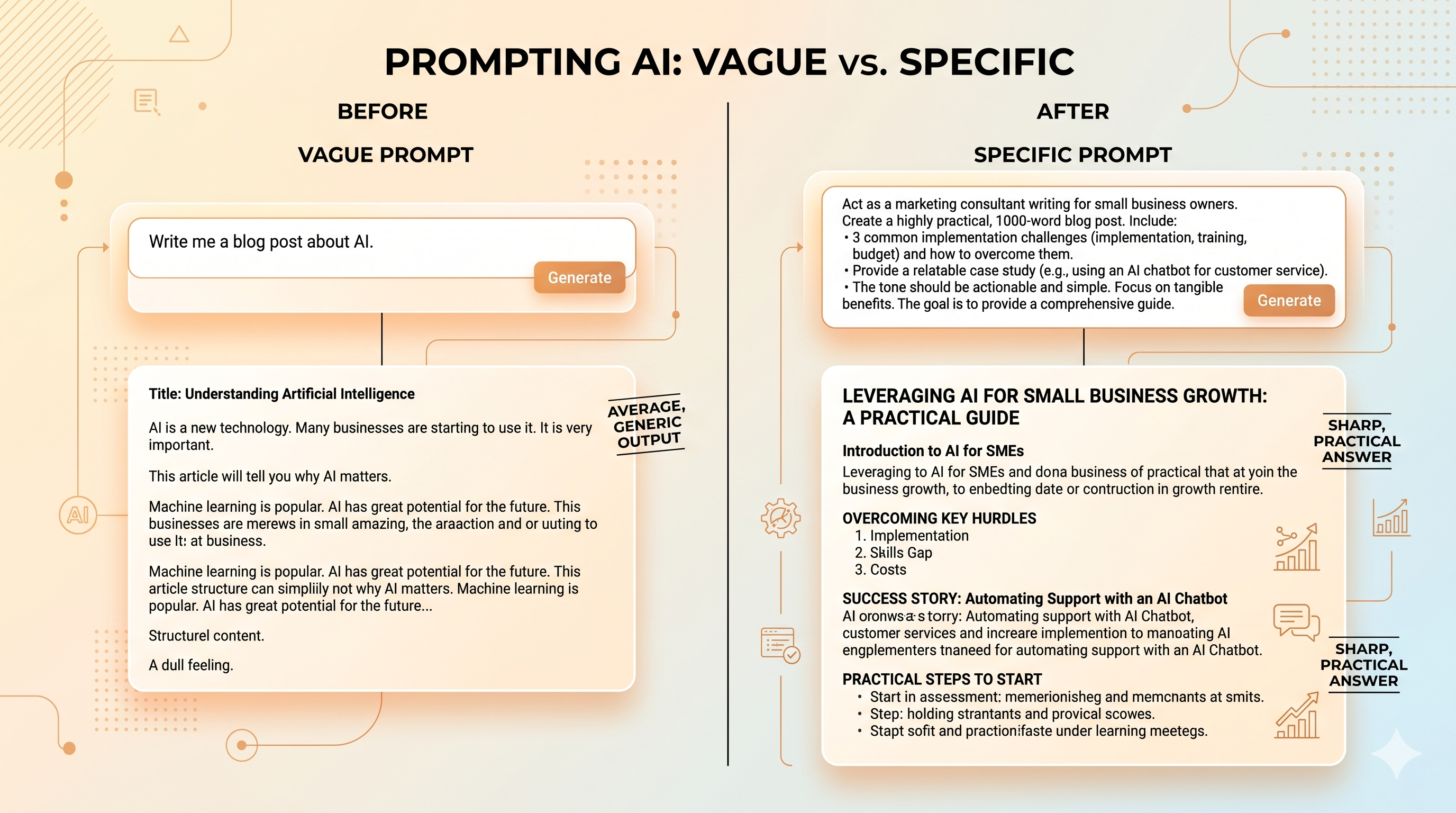
Most people prompt like this:
"Make this email better."
A stronger prompt sounds like this:
"Rewrite this cold outreach email for a small business owner who is busy and skeptical. Keep it under 80 words. Make it warm, direct, and easy to reply to. End by asking if they want me to send a short example."
The difference is not technical skill. It is clear direction.
The Clear Prompt Formula
A useful prompt usually has five parts. You will not always need all five, but they give you a reliable starting point.
1. Role
Tell the AI what kind of help you want.
"Act like an editor..." "Help me think like a customer..."
2. Task
Say exactly what you want it to create or improve.
"Write three versions of this email..." "Pull the main objections from this call transcript..."
3. Context
Give the background the AI would not know.
"Here is the audience. Here is the draft. Here is what did not work last time."
4. Format
Tell it how the answer should look.
"Return a table with three columns." "Give me a numbered list with one sentence per item."
5. Boundaries
Name what to avoid or keep in mind.
"Avoid jargon. Keep it friendly. Do not make promises we cannot prove."
Prompts Are Work Instructions
A strong prompt is not magic wording. It is a clear work instruction.
When you write a prompt, imagine you are handing a task to a new assistant. If the assistant would have to guess what you mean, the AI will probably guess too.
Weak instruction:
Make me content ideas.Better work instruction:
Create 10 short-form video ideas for a beginner freelance graphic designer who wants to attract local business clients. Focus on practical tips, common client mistakes, and before/after examples. Return the ideas in a table with: Hook, Topic, Why It Works, and CTA. Keep the tone simple and useful.Before you send a prompt, ask:
- Does the AI know the goal?
- Does it know who the output is for?
- Does it know what format I want?
- Does it know what to avoid?
- Could I reuse this prompt again next week?
Good operators do not just ask AI for answers. They build reusable instructions.
Multiple Choice
Which prompt is more reusable?
Practice: Build a Better Prompt
Matching
Match each prompt part to what it does.
Role
Task
Context
Format
Boundaries
Write Your First Strong Prompt
Rate my prompt — how many rubric items can you hit?
Your Mission
Write a clear prompt to generate a one-week social media content plan for a freelance graphic designer. It must be ready to paste into ChatGPT or Claude and produce something actually usable.
Use the formula: Role, Task, Context, Format, Boundaries. Do not skip Format; that is the most commonly missed piece.
In the next lesson we will put this into practice with a task many people need every week: creating useful content without starting from a blank page.
The Power of Revision
Your first answer is a draft, not the final result. Better AI users revise:
- Get the first output
- Notice what is off: too long, too stiff, missing a point, wrong tone
- Give one specific correction: "The second paragraph is too formal. Rewrite it like you are explaining this to a smart friend over coffee."
- Repeat until it works
Three small revisions usually beat one giant prompt.
Multiple Choice
AI gives you an email draft that is too formal. What is the best next move?
Multiple Choice